
_fix_.png)
Combustion Chemical Reaction Analysis Platform
What is Reaction Bench?
Reaction Bench is a simulation platform for combustion chemical reaction analysis based on Cantera. With a GUI interface that requires no programming, it provides an environment for efficiently performing combustion analyses necessary for research and development, from basic analyses such as ignition delay and laminar flow combustion velocity to applied analyses of reciprocating engines.
Aiming contribution
Further development of combustion technology and system development
Promoting the expansion of advanced chemical reaction calculation environments
Human resource development in chemical reaction analysis
Suitable customers
Further development of combustion technology and system development
Promoting the expansion of advanced chemical reaction calculation environments
Human resource development in chemical reaction analysis
Advanced chemical reaction analysis in one browser.
Intuitive setup with no coding required.
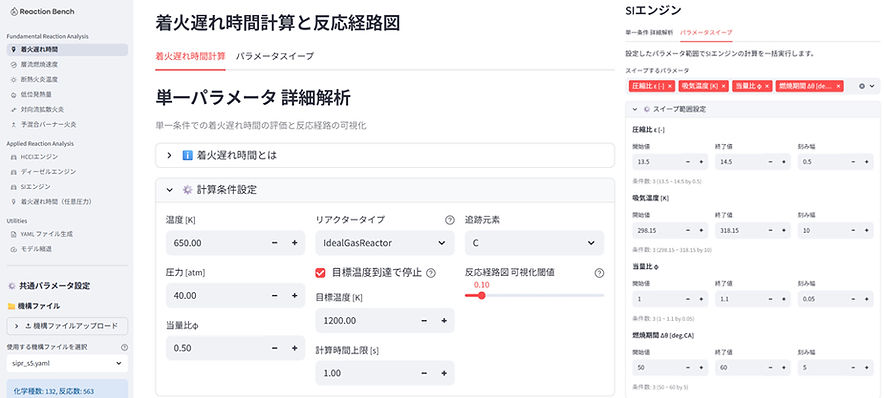
Rich combustion analysis and visualization tools.

Main functions and analysis menus
Fundamental License
(Basic analysis)
-
Further development of combustion technology and system development
-
Promoting the expansion of advanced chemical reaction calculation environments
-
Human resource development in chemical reaction analysis
Professional License
(For system development)
-
Reciprocating engine combustion
-
HCC I engine
-
Premixed SI combustion engine
-
Multi-stage injection diesel engine
-
-
Arbitrary pressure history, ignition delay
Common Features
-
YAML file generation
-
Parametric study function
-
Reaction path and sensitivity analysis
-
Interactive 3D plots, etc.
e-learning course (beginner to intermediate level):
Learning combustion chemical reaction calculations from scratch using Reaction Bench
New
We aim to understand the fundamentals of combustion chemical reactions and apply them to interpreting complex phenomena and developing engines.
Beginner/Intermediate Course Learning Roadmap
STEP 1 | Preparing the Environment
-
Understanding basic operations and reaction mechanisms (chemical species, thermophysical properties, elementary reactions, etc.)
STEP 2 | Fuel calorific value
-
Calculation of fuel calorific value, understanding of fuels that can be considered in a given reaction mechanism
STEP 3 | Calculation of Ignition Delay
-
Understanding autoignition, interpreting ignition delay calculation results, and verifying reaction pathway diagrams.
-
From the Arrhenius plot to an interpretation of Cold Flame and NTC
STEP 4 | Calculation of Laminar Combustion Velocity
-
Understanding flame structure (temperature, chemical species, heat generation rate)
-
Understanding the impact of fuel type, equivalent ratio, and transport model
STEP 5 | Calculations for a reciprocating engine
-
Understanding HCCI, Diesel, and SI Calculation Models and Calculation Settings
-
Visualization of combustion characteristics using parameter sweeping
-
Understanding the Early-Closed Miller Cycle Combustion Concept Using Optimization


Main functions and analysis menus
-
Format: On-demand e-learning (self-study type)
-
Duration and price: Please inquire.
-
Various support programs are available.
-
-
Contents: Technical explanation materials and Reaction Bench exercise environment
e-learning course (advanced):
From the generation of reaction mechanisms to a deeper understanding and application of those mechanisms.
Coming soon
Our goal is to understand the details of the reaction mechanism, starting from the generation of the reaction mechanism, and to apply this knowledge to the development of internal combustion engines.
Advanced Course Skill-Up Themes
Automatic generation of reaction mechanisms
Learning SMILES description for generating reaction mechanisms
Automatic generation of reaction mechanisms using KUCRS and investigation of surrogate mechanisms
Detailed analysis of the reaction mechanism
Identifying dominant responses through ROP and sensitivity analysis
Understanding the Low-Temperature Oxidation, NTC, and H2O2 Loop
Learning the Extended Zeldovitch Mechanism and Understanding Thermal NOx Generation
Theoretical background of transport models and the Soret effect
Application to engine development challenges (case study exercise)
Searching for the optimal fuel mixture using actual engine cylinder pressure.
Understanding the chemical reactions and knocking characteristics of lean combustion and EGR combustion
Understanding the impact of unburned CO and H2 losses in rich combustion
Considerations on ammonia-hydrogen co-firing and NOx emissions
e-learning overview
-
Format: On-demand e-learning (self-study type)
-
Duration and price: Please inquire.
-
Various support programs are available.
-
-
Contents: Technical explanation materials and Reaction Bench exercise environment
Introduction Video
TECH BLOG
We will be sharing information ranging from the development background of Reaction Bench to the basic analysis of combustion chemical reactions and their development and applications, so please take a look.
_fix_251230.jpg)
PRODUCT STORY
On the release of Reaction Bench
-
We'll introduce the background behind the development, the logo design, and more.

COMBUSTION
NTC Region and Cold Flames: Deciphering Arrhenius Plots of Ignition Delay
-
We will decipher the mechanism of low-temperature oxidation and cold flames from ignition delay analysis.

APPLICATION
Exploring the potential of early-closing mirror cycles and higher compression ratios through Bayesian optimization
-
This article introduces examples of using SI engine models and Bayesian optimization for design exploration.